
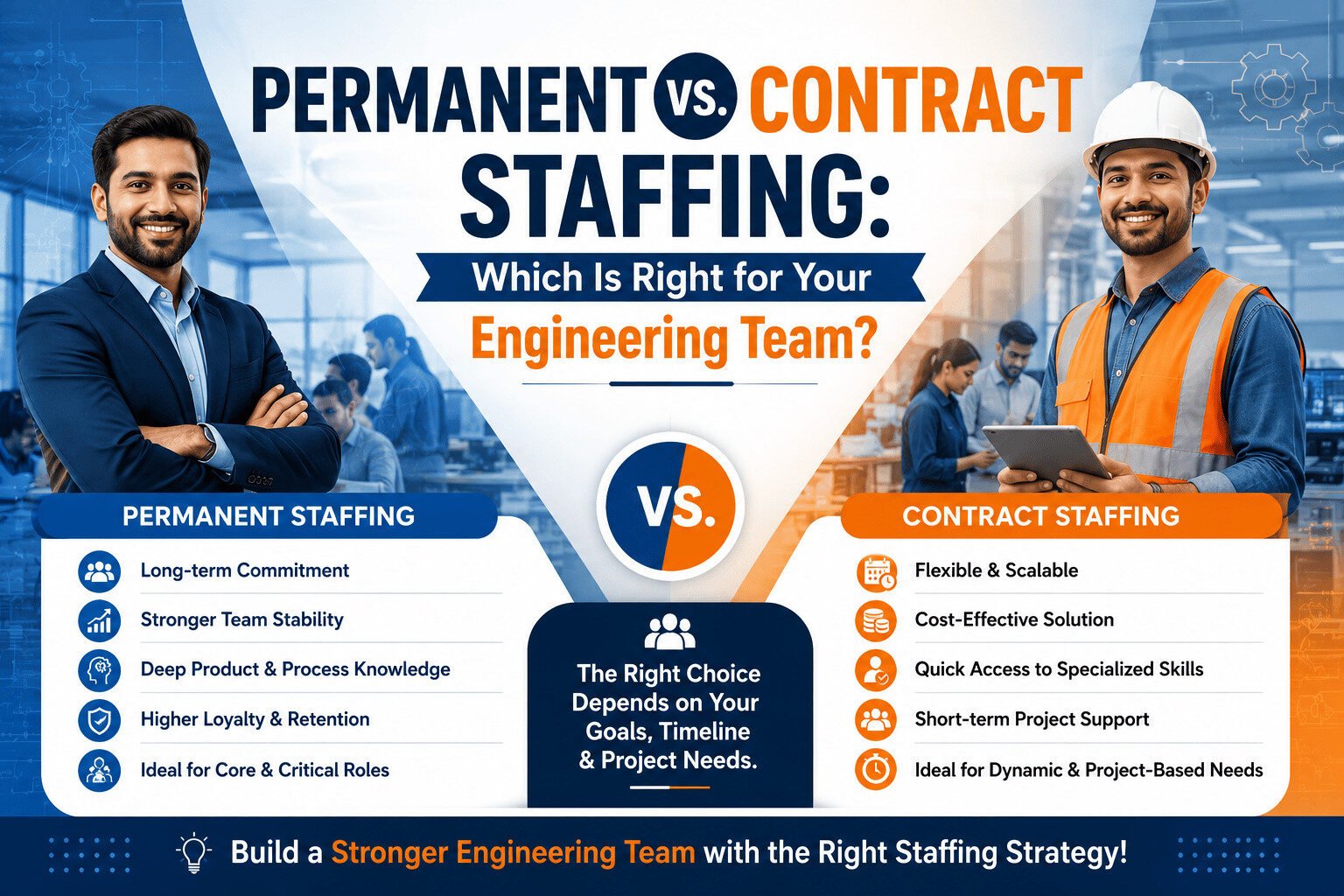
Building a high-performing engineering team is one of the most critical challenges tech leaders face. In an industrial and technology hub like Ahmedabad-where manufacturing, infrastructure, IT, and Global Capability Centers (GCCs) are expanding at a rapid pace-the competition for top-tier engineering talent is fierce.
When a new project lands or your workload increases, you face a pivotal strategic decision: Should you hire a permanent full-time engineer, or bring in specialized contract talent?
Making the wrong choice can stall your project timelines or drain your annual budget. Let’s break down the distinct advantages of both permanent and contract staffing to help you choose the right path for your team.
The Case for Permanent Staffing: Building Long-Term Core Equity
Permanent staffing means hiring full-time employees who grow alongside your organization. They are the backbone of your core product, intellectual property, and engineering culture.
When to Choose Permanent Hiring:
- Core IP and Product Development: If engineers are building the foundational architecture of your software or proprietary manufacturing systems, you want that institutional knowledge to remain within your company.
- Cultivating Leadership: Full-time engineers sink roots into your organization. Over time, they transition into team leads, architects, and engineering managers who understand your long-term business goals.
- Consistent, Long-Term Workload: If the pipeline of engineering work is steady and predictable for the next two to five years, a permanent hire is the most financially sound investment.
The Long-Term Value: Full-time employees offer high organizational stability and deep alignment with company values. However, the onboarding process is typically longer, and the long-term financial commitments (including payroll, benefits, and compliance) are substantial.
The Case for Contract Staffing: Agility, Speed, and Specialized Skills
Contract staffing involves bringing in skilled engineering professionals on an on-demand, project-specific basis. This approach gives engineering managers the agility needed to respond swiftly to volatile market demands.
When to Choose Contract Staffing:
- Handling Peak Workloads & Deadlines: If you need to scale up your team quickly to meet a tight client delivery deadline but know the workload will normalize in six months, contract staffing prevents over-hiring.
- Niche Expertise for Specific Projects: Sometimes a project requires specialized knowledge-like a niche cloud architecture certification or specific automation engineering experience-that your internal team lacks and won’t need once the project goes live.
- Budget Flexibility: Contract staffing allows you to utilize project-specific budgets (CapEx) rather than tying up long-term operational costs (OpEx).
Side-by-Side Comparison: Permanent vs. Contract Staffing
To help you evaluate your current engineering requirements at a glance, here is how both models stack up across key business operational metrics:
| Metric | Permanent Staffing | Contract Staffing |
| Time-to-Hire | Typically 30-90 days (multi-stage vetting) | Fast onboarding, often within days |
| Financial Structure | Fixed long-term salary + benefits & overhead | Variable hourly/monthly rate based on output |
| Flexibility | Low flexibility; long-term commitment | High flexibility; easy to scale up or down |
| Institutional Knowledge | Retained deeply within the company | Leaves with the contractor upon project end |
| Training Required | High investment in long-term upskilling | Minimal; contractors are expected to hit the ground running |
